
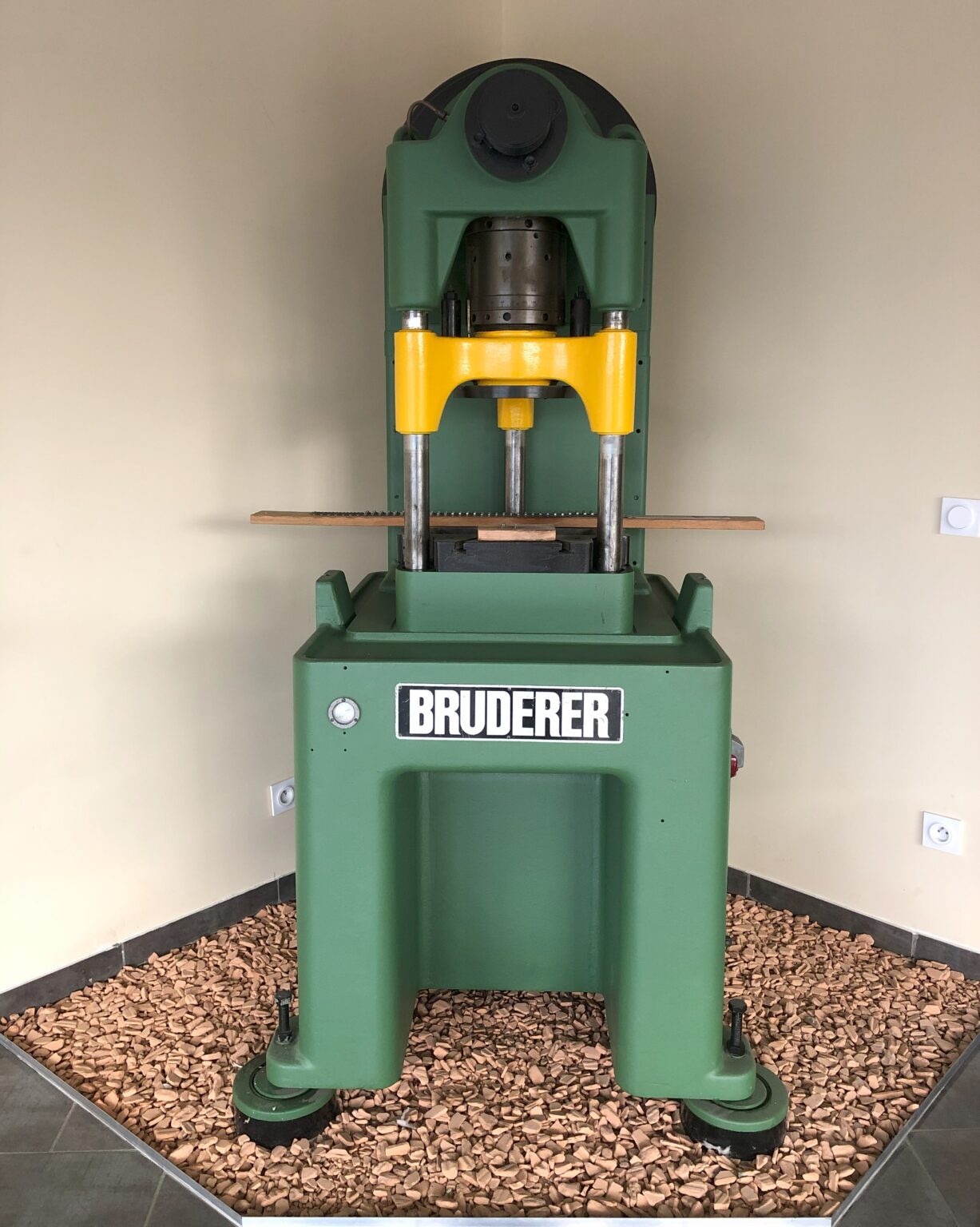
Definition:
An industrial press is a machine used to exert strong pressure on materials, often in manufacturing processes. It is primarily used to transform or shape materials such as metal, plastic, cardboard, or rubber, by compressing, cutting, or molding them. Industrial presses are essential in sectors such as automotive, electronics, and packaging, particularly food, where they enable the production of precise, high-quality parts in large quantities. There are several types of presses (mechanical, hydraulic, pneumatic, roller presses, forming presses, etc.), each adapted to specific uses and different materials.
Mechanical Presses:
A mechanical press is a powerful piece of industrial equipment used to apply significant force to various materials, primarily for cutting, forming, or stamping. This type of press operates using a mechanical mechanism, where a motor transmits power through a system of gears, shafts, and belts.
It is widely used in sectors such as metallurgy, automotive, and plastic parts manufacturing. Mechanical presses are particularly effective for rapid operations, especially during mass production. Their speed of action allows for high productivity, although precise force control is less than that of hydraulic or pneumatic presses.
They are particularly suitable for applications requiring speed and power, such as cutting metal parts. However, they are less suited for processes requiring extreme pressure or precise force control. In short, the mechanical press remains an essential tool for many processing industries.
Hydraulic Presses:
A hydraulic press is an essential piece of industrial equipment used to apply high pressure to various materials using a hydraulic system. This system allows for precise control of the applied force, making the press ideal for applications requiring high power and fine control. Hydraulic presses are commonly used in sectors such as metallurgy, plastics, and automotive for operations such as forming, stamping, and compression.
Unlike mechanical presses, they offer greater flexibility and can handle tougher materials, while ensuring greater precision. Their ability to generate constant force makes them suitable for long and repetitive tasks, such as the manufacture of metal components or molded plastic parts.
In summary, the hydraulic press is an essential tool in many industries for applications requiring power, precision, and efficiency.
Learn more about hydraulic presses…
Pneumatic presses:
A pneumatic press is an industrial machine that uses compressed air to generate pressure and perform various forming, cutting, or assembly operations. This technology provides rapid and constant force, ideal for light-duty and precision tasks. Pneumatic presses are commonly used in sectors such as automotive, plastic parts manufacturing, and packaging.
Their main characteristic is their speed of action, making them suitable for mass production applications. Unlike mechanical or hydraulic presses, pneumatic presses are simpler, less expensive, and easier to maintain. They are also quieter and consume less energy than other types of presses.
Thanks to their flexibility, pneumatic presses can be used for cutting, assembling, or forming small parts with great precision. In short, the pneumatic press is an effective solution for industrial needs requiring speed, precision, and simplicity.
Roller presses:
A roller press is an industrial machine used to apply uniform pressure to materials through two rotating rollers. This type of press is particularly effective for forming, rolling, or calendering processes on materials such as metal, rubber, or plastic. Roller presses are commonly used in industries such as metallurgy, plastics, and paper manufacturing.
They allow materials to be processed by controlled stretching or crushing. Thanks to their ability to process large materials and their high productivity, roller presses are ideal for mass production applications. Furthermore, they guarantee optimal surface quality and consistent precision. This type of press is also appreciated for its ease of use and robustness.
In summary, the roller press is an essential tool for industrial applications requiring speed, efficiency, and quality.
Forming presses:
A forming press is an industrial machine used to transform materials such as metal, plastic, or rubber into specific parts by applying pressure to the material. This type of press is widely used in sectors such as automotive, aerospace, and industrial parts manufacturing.
Forming presses are particularly effective for operations such as stamping, molding, or drawing complex parts. They allow for the creation of precise and detailed shapes while maintaining consistent quality. Their power and precision make them suitable for applications requiring high forces and precise control.
This type of press is also used in mass production lines, ensuring high productivity. In short, the forming press is an essential tool for the production of complex parts, offering speed, precision, and flexibility.
To summarize, there are three main types of presses, the most commonly used in the industrial sector: mechanical presses, hydraulic presses, and pneumatic presses.
These three types of presses serve the same purpose but have different advantages.
However, there are other types of presses used to further process materials by stretching or molding them, such as roller presses, forming presses, and many others.