
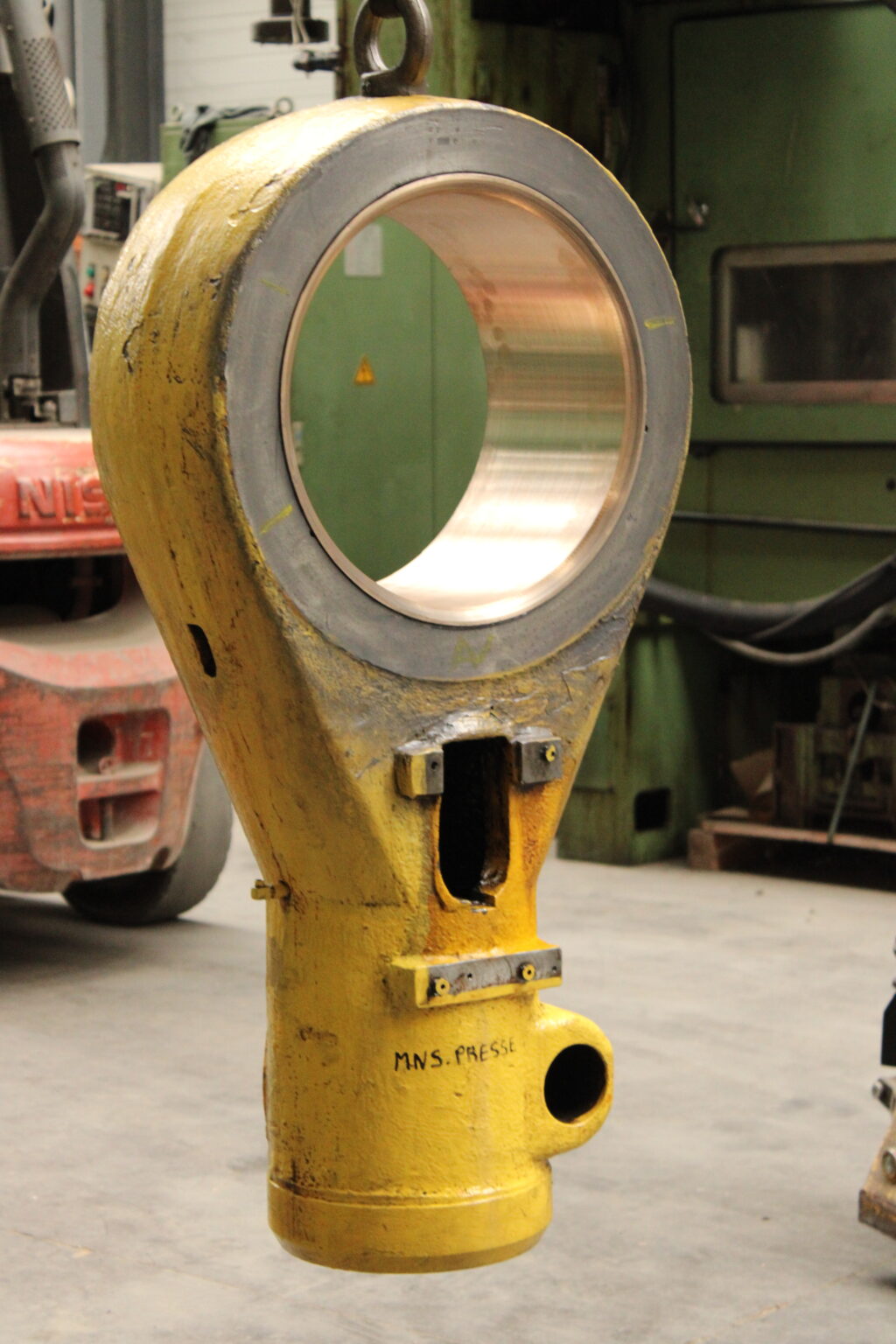
The connecting rod is an essential component in many engines and machines, especially in industrial presses, yet it often remains unknown to the general public. However, it plays a fundamental role in energy conversion and the proper functioning of various technologies, whether car engines, industrial engines, or other mechanisms. In this article, we explain what a connecting rod is, its role, and its importance in mechanical systems.
Definition of a connecting rod
A connecting rod is a metal part, usually made of steel, that connects two elements of a mechanism, allowing linear motion to be transformed into circular motion, or vice versa. In the case of an internal combustion engine, for example, the connecting rod connects the piston, which performs linear motion, to the crankshaft, which performs circular motion. This transfer of motion is crucial to the engine’s operation.
The Different Parts of the Connecting Rod
A connecting rod generally consists of several components:
The big end: This is the part connected to the piston. It is generally equipped with a crankpin or an end piece to attach the rod to the piston.
The connecting rod body: This is the central, elongated part that supports the tension and compression generated by the engine. It must be strong enough to withstand significant forces without deforming.
The connecting rod leg: This is connected to the crankshaft, allowing for circular motion. It also includes a crankpin that secures the connecting rod to the crankshaft.
Materials Used to Manufacture the Connecting Rod
Connecting rods are generally made of steel or steel alloys, sometimes with specific heat treatments to enhance their strength. In some high-performance engines, lighter materials such as titanium or aluminum may also be used to reduce the mass of moving components and improve engine performance.
The Connecting Rod in Other Mechanisms
Although the connecting rod is best known for its role in engines, it is also used in other types of mechanisms. For example, it is present in the piston systems used in certain industrial tools, or in machines such as piston pumps.
In engineering, connecting rods are also used in mechanisms where linear motion must be converted into circular motion, or vice versa. They are found in agricultural machinery, presses, and even in some steam engine manufacturing applications.
Common Connecting Rod Problems
Connecting rods are subjected to significant stress, especially in high-performance engines. Poor maintenance, insufficient lubrication, or extreme operating conditions can cause premature wear. This can result in abnormal noise, loss of power, or even total engine failure.
One of the most common connecting rod failures is “rod failure.” This failure can occur when the connecting rod breaks under excessive force, often as a result of overheating or lack of lubrication. This situation is often catastrophic for the engine and requires major repair.